The canalmen
« Nous, on nous appelle les gens d’à bord ou les gens du bord. A bord du bateau alors que ceux qui sont à terre sont ceux qui sont sur le plancher des vaches. Ca fait la différence. »
Commande du DVD ou Blu-Ray
"Les gens d'à bord"
Votre commande vous sera expédiée dès réception de votre règlement par chèque libellé à l’ordre de « Marc Gossard, Vidéaste » à l’adresse suivante:
15 Bis rue Humières 60200 COMPIEGNE
Pour passer commande, contactez nous par mail ou par appel téléphonique. Nos équipes vous garantissent une réponse dans les plus brefs délais.
The super 8 family archives of Daniel Wattiau takes us back to this bygone era when canal craft evoked a free and itinerant way of life, this idyllic image rooted in the collective imagination of popular culture. Jean-Claude, a young bargeman offers a contemporary counterpoint relayed by the testimonies of retired mariners of Longueil- Annel. This village still keeps the histories and living testimonies of these ''water people'' passing on their heritage through the waterway festival.
Flat edge, macaroon, ecouart, odds and ends, scull, boulard, marquise ... so many words which in my ears had very little resonance. And yet all this strange jargon became familiar to me when I got in touch with the elders of Longueil Annel when in 2008, charged by the museum of inland waterways, I carried out a dozen interviews with couples of former boatmen. It was the discovery of Daniel Wattiau's Super 8 archives that convinced me to continue my work with this documentary project. They evoke the timelessness and poetry of Jean Vigo's "Atalante" and allow me to anchor the world of inland shipping in the collective imagination in a cinematic way.
Longueil Annel, a city of boatmasters memory
Longueil-Annel is a town located in the department of Oise in the Picardy region. The inhabitants have for the most part a bond with the inland waterways. They are a part of history, of boat memory and it is not for nothing that on the day of disembarking they choose to settle here, near the canal. Here, the side canal at the Oise, built in 1835, allowed more traffic for the barges.
Between 1900 and 1950 the abundant activity of river transport still gave the village a particular color. Thus, the village and its thirty cafes and breweries could count in the evening up to 400 more inhabitants and a hundred boats waiting. The story of the "people on board", which I want to tell, is rooted in this village, an essential crossroads of waterways. The natural decor of the quays crossing this village is today so calm, almost deserted, while yesterday it was teeming with life, passages, shops and exchanges ...
Daniel Wattiau's super 8 family archives: "Happy who like Ulysses had a great trip"
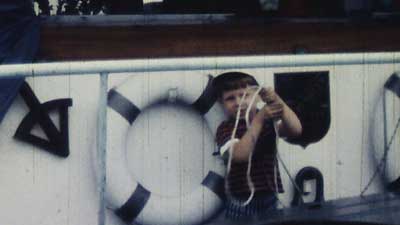
Daniel Wattiau is an 88-year-old retired sailor who lived in Conflans St Honorine. In the seventies, he filmed on his boat "Le Rove", his family and his travels for ten years. His images take us to the Haute Seine, Belgium, Amsterdam, Rouen, Zeeland etc. By the eye of his camera we navigate on all types of canals, at sea, we pass lying dams, we cross cities, small corners of wild countryside.
The technical and artistic quality of Super 8 films is remarkable. The spectator is truly immersed in the intimacy of the family, the boat, the life of a sailor. The father brilliantly films moments of daily joy, recreational and playful moments from which emanate a feeling of freedom, an impression of continuous movement.
The old boatmen-guides, the living pieces of the museum
Ils sont des passeurs de savoir, de savoir faire…Ils font une visite guidée de leur propre vie, dernier lien concret qui leur permet d’exprimer leur passion, leur mode de vie, leur liberté d’antan. L’association des bateliers de Longueuil est, pour eux, le dernier exutoire d’une vie nouvelle de sédentaire. Ils éclairent les visiteurs sur un monde méconnu, une profession dont la réputation fut longtemps noircie par l’illettrisme et l’alcool.
En activité, ils trouvaient leur équilibre dans le mouvement. Retraités, ils sont d’un certain point de vue inadaptés à cette vie nouvelle, celle des «gens d’à terre». Pour les comprendre, il faut penser à l’émotion de voyageurs qui, découragés par la crise de la batellerie des années 70, ont pris la décision de débarquer avec leur épouse ; cela signifie abandonner le métier de transporteur par eau, et surtout la vie à bord qu’ils n’ont pratiquement jamais quittées depuis leur naissance.
Ce choc émotionnel leur a donné envie de faire connaître ce métier, par l’expression orale. Ils ont connu toute l’évolution de la batellerie, du halage aux automoteurs modernes. L’historique de leurs bateaux successifs est un exemple de l’évolution des artisans bateliers. Plus que des «guides» de la cité batelière, ils en sont l’âme. Ils participent à la vie culturelle à bord, et partagent leur expérience avec les visiteurs.
Jean-Claude Biencourt
Jean-Claude Biencourt is 26 years old, he is the 7th generation of boatman in the family. He sails between La Fère in the Aisne and Gennevilliers in the Paris region. He chose to be an employee at Cemex, a company that manufactures and transports gravel for public works, preferring job security and getting closer to his son. Each transport of gravel takes 2 days, and when it has unloaded, it goes back empty in 1 and a half days to La Fère to start again.
Its Freycinet type boat is nothing modern, no radar , no autopilot, not even a propellant, just a good old-fashioned "old-fashioned" badge, as he says. Jean-Claude apprehends the visit of the expert who comes to check his compliance with navigation standards.
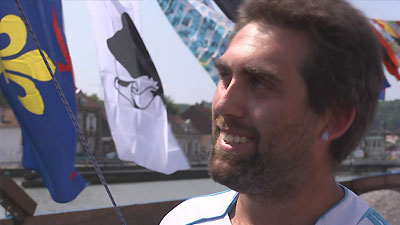
Il vit seul désormais sur son bateau depuis que sa fiancée qui a essayé de vivre à bord a débarqué. Une fois par semaine, il débarque à Beautor et va voir son fils de 2 ans et demi qui vit avec sa mère à Tergnier. Deux jours avant le pardon de la batellerie, il ponce, repeint et pavoise son bateau. Après l’avoir embellit de belles couleurs, il attache méticuleusement, un à un, une trentaine de drapeaux…c’est la première fois qu’il participe au «pardon». Ses grands-parents avant lui y avaient participé, il assure donc «la relève» avec fierté. Mais les difficultés s’accumulent et Jean-Claude songe à tout arrêter.